Chem Standard 11g: Students know protons and neutrons have substructures and consist of particles called quarks.
A substructure is any basic structure or organization.
A quark is an elementary particle and a fundamental constituent of matter. Quarks combine to form composite particles called hadrons.
A hadron is a composite particle made of quarks held together by the strong force. Hadrons are categorized into two families: baryons ( made of three quarks), and mesons ( made of one quark and one antiquark). The best-known hadrons are protons and neutrons (both baryons), which can be found in the atomic nuclei. All hadrons except protons are unstable and undergo particle decay–however neutrons are stable when found inside the atomic nuclei. The best-known mesons are the pions and kaons, which were discovered during cosmic ray experiments during the late 1940s and early 1950s.
There are six types of quarks, known as flavors: up, down, charm, strange, top, and bottom. Up and down quarks have the lowest masses of all quarks. The heavier quarks rapidly change into up and down quarks through a process of particle decay: the transformation from a higher mass state to a lower mass state. Because of this, up and down quarks are generally stable and the most common in the universe, where as charm, strange, top, and bottom quarks can only be produced in high energy collisions.
The proton is a subatomic particle with an electric charge of +1 elementary charge. It is found in the nucleus of each atom, along with neutrons, but is also stable by itself and has a second identity as the hydrogen ion, H+. It is composed of three fundamental particles: two up quarks and one down quark.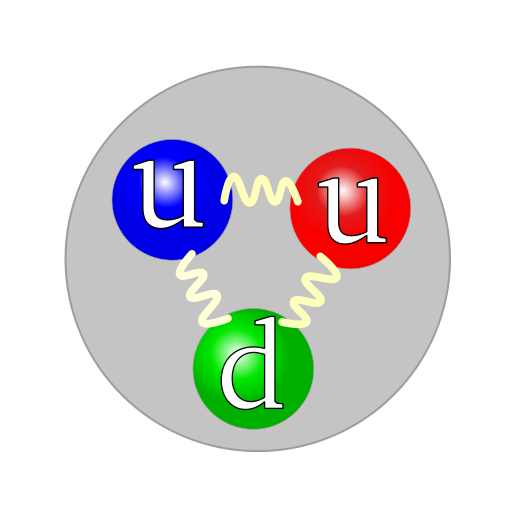
A quark is an elementary particle and a fundamental constituent of matter. Quarks combine to form composite particles called hadrons.
A hadron is a composite particle made of quarks held together by the strong force. Hadrons are categorized into two families: baryons ( made of three quarks), and mesons ( made of one quark and one antiquark). The best-known hadrons are protons and neutrons (both baryons), which can be found in the atomic nuclei. All hadrons except protons are unstable and undergo particle decay–however neutrons are stable when found inside the atomic nuclei. The best-known mesons are the pions and kaons, which were discovered during cosmic ray experiments during the late 1940s and early 1950s.
There are six types of quarks, known as flavors: up, down, charm, strange, top, and bottom. Up and down quarks have the lowest masses of all quarks. The heavier quarks rapidly change into up and down quarks through a process of particle decay: the transformation from a higher mass state to a lower mass state. Because of this, up and down quarks are generally stable and the most common in the universe, where as charm, strange, top, and bottom quarks can only be produced in high energy collisions.
The proton is a subatomic particle with an electric charge of +1 elementary charge. It is found in the nucleus of each atom, along with neutrons, but is also stable by itself and has a second identity as the hydrogen ion, H+. It is composed of three fundamental particles: two up quarks and one down quark.


No comments:
Post a Comment